Thursday, 17 November 2022

Moondog -1

Moondog - Moondog 2 (1971)

This may be Moondog 2, but it's hard not to feel like it was a step back from simply Moondog. Gone was the orchestral, epic, and lyrical breadth of the latter (a singular third stream masterpiece, which did full justice to the man's uniquely syncretic musical personality, and to his headgear as well - gearing you to ride up to snowed-in norden castles and warm up to aloof ice princesses, with Benny Goodman as your squire), in favor of a return to (up to that point) more traditional Moondog fare, caught in a nonsensically playful somewhere between Dada and Lear (Edward, not King, et pour cause), that included him having recorded with Julie Andrews. 
So, significantly joining forces with his young daughter June and not so much a band of horned musical assailants, we are left here with an eccentric collection (almost experimental, given the formal microscale of the compositions and skeleton crew aboard) of contrapuntal sketches, domestic rounds, and nursery rhymes. Whimsical, for sure - perhaps, on occasion, endearingly so, as if this could be closer to Louis Hardin the man, than to his public New York city street viking persona (should that distinction even apply; although, based on his getup, I would hardly have envisoned him fathering children, so it just might) - but, as it turns out, even presented by the ineffable Moondog and his unfaltering tom-toms, it would seem that, much like your regular viking, I just cannot fill up on hors d’oeuvres. 
No need to complain, though; it was simply a matter of waiting: In Europe, things would get regal again.


Sunday, 25 September 2022

Univers Zéro - Crawling Wind (1983, EP)

Toujours Plus à l'Est is almost counterintuitive for a Univers Zéro track, and yet it's my go to one when I need a quick fix. Technically it is very much their own work, all syncopation times square, but at the same time it just sounds out of character, joyfully glorious (even if still slightly menacing in its sheer energy; like a big cat brought up in captivity still can't discern by human patterns when it might be playing too rough with its handlers), as if it came from a parallel universe where Daniel Denis had learned to use major chords in composition, or hadn't been exposed to Lovecraft in his youth. 
Followed swiftly in the track sequence by the exacting (and very much on the nose) gloom of "Before the Heat" and "Central Belgium in the Dark", clearly that wasn't meant to last, though; so the brilliance of Toujours Plus à l'Est, alongside all lost hopes and dreams, stands on, across the multiverse, as a shining beacon for the path not taken.

Thursday, 18 August 2022

Tangerine Dream – Ultima Thule (1971, 7')

A tumultuous early single (drums, yeah) that perfectly condenses Tangerine Dream's initial psychedelic phase (also pairing beautifully, in a yin/yang sort of way, with their Oszillator Planet Concert track, on the everything and the kitchen sink krautfest Ossiach Live, from the same year), which means it comes with the additional appeal of probably constituting a shocker for all those who identify their entire career with sequencer-based electronic tantrism. 
Sturm und drang, bitches.


Friday, 12 August 2022

V.A. - The Last Nightingale (1984, EP)

A various artists EP produced by avant-everything Chris Cutler's Recommended Records in support of the miners' strikes of the 80's in the UK, and most notable for containing two original tracks combining the mighty forces of Robert Wyatt and part of the Henry Cow combo (along with a reprisal of the latter's Bittern Storm and two readings of Adrian Mitchell's poetry, which are not so likely to stick with you; all of it fronted by Ralph Steadman's bleak cover art and sprinkled with Peter Blegvad doodles). 
Other considerations aside, that might seem like slim musical pickings at first; but those two sharp shards of sonic and political unrest have yet to be reinstated and given their proper place in either contributors' towering catalogues (how did they not feature in the second disc of Wyatt's Different Every Time, anthologizing his collaborative work, is quite puzzling) while, their obscurity notwithstanding, they stand head and shoulders with the finer things in both of them. 
All in all, it's a most effective antidote for when you get cynical about musicians trying to save the world through good intentions and bad songs, and a perfect example of the Rock in Opposition ethos: activism in art should be the opposite of artistic compromise. 


Monday, 8 August 2022

Rendition, rendition, rendition

Glaxo Babies - This Is Your Life (1979, EP)

On paper, this EP may appear to have quickly become completely redundant, as all of its tracks reappeared shortly after its release on the odds and sods Put Me on the Guest List LP (1980); except, they mostly did in rather inferior form. In the former they were alive, piercing post-punkish observations on the as subtle as wearing everyday mismatches between social and subjective life ("This is your life / Crying in the subway / Lying to your wife" always feels like an indictment to me, despite my being a very good boy); in the latter they sounded bloodless, stripped, dubbed up and slowed down, like contrived artistic statements on anomy (what difference a little tempo change can make); so, I will take this short release over that whole LP any day of my emotionally hampered life. If you're gonna wish for the downfall of society, say it like you mean it.

Monday, 13 June 2022

Officer! - Ossification (1984)

Mick Hobbs discreetely paid his dues in the UK post-punk-prog scene (that is a thing), only to discreetely pour out his confoundingly charming soul under the Officer moniker (gathering around him many other splendid self-rejects from any semblance of the mainstream) and presumably carry discreetely on henceforth, as I am still to hear the sonorous accolades that, if the world were a fairer and quirkier place, he should have had coming his way all this oblivious time. 
Officer's other collections of let's-call-them-songs, "released" in obscure tapes (the bulk of which most likely ended up stored in a few damp and dusty attics in some non-disclosed old european capitals), can be a bit of a I-don't-much-care-if-I-hit-or-miss affair (but, more often than not, still hitting something - both random objects and our capacity to feel, as in the poignant Life at the Water's Edge, from their eponymous release). 
Losing nothing of that lackadaisical approach - i.e. still appearing less to compose songs than to assemble them from disparate bits and pieces of what others might consider musical refuse - Ossification is a definitive statement though, and a most brilliant work of clunky genius. 
Sneaked in just about the time Tom Waits done did a hostile takeover on that aesthetic with Swordfishtrombones (in turn, also his absolute masterpiece; not that anyone asked), instead of Waits' pack of misanthropic mutants breeding an underground strain of blues, here you meet up with a troupe of minstrels scraping by in the cracks of the faltering industrial age, armed only with a host of decommissioned instruments salvaged from the local concert hall dumpster, and an anthology of oulipesque limericks full of that sort of british nonsensical wit that makes it so very hard to run counter the continual reproduction of some cultural stereotypes. To quote solely one of my favourite snippets, from "Origin": "Let's find something really big and call it a god". 
It's always most instructive to be reminded, against our mathematical notions of perfection, how beauty can be brought about into this world in such magnificently messy ways. 


Wednesday, 26 January 2022

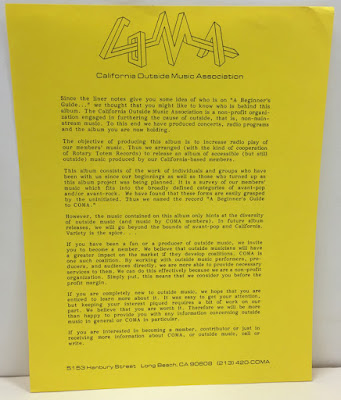
V.A. - A Beginner's Guide to COMA (1985)

A treasure trove of underground prog from when, pairing the formal inquisitiveness of the format with a more DIY garagey m.o. (no orchestra for you) and a twisted outlook on the general notion of reality, some sort of progressive scene (even if no longer self-described as such) finally caught on aesthetically (and in no other way) in the USA, which begs the philosophical question this gestalteanly wacky sampler from Rotary Totem Records (founded by James Grigsby, of Motor Totemist Guild and U-Totem, ehr, fame?), for the proto-pynchonesque "California Outside Music Association" = COMA (manifesto included), preemptively strove (while ultimately knowing it couldn't help but fail) to clarify: if the 80's had actually been a great decade for real progressive music, but no one was then to hear it, did it really make a sound?


Wednesday, 8 December 2021

Riccardo Cocciante - Mu (1972)

Now that the letters of the greek alphabet, such as Mu, are getting a (literally and metaphorically viral) bad wrap, through no fault of their own, it is perhaps time for us to be reminded that letters, syllables, the words they make up, are all just innocent victims of how we choose to name things, and "Mu" - from cows to Cocciante, by way of crypto history loonies - has been for centuries a consistent source of entertainment, one that deserved a better fate in popular memory. 
Take for instance this record which, unlike new SARS-CoV-2 variants, is a nice surprise; one I wouldn’t have expected to find while scraping down the barrels of Italian singer-songwriter prog: that’s like a cocktail mixing amaretto, limoncello and grappa; what could possibly go wrong? Well, go figure, not all that much, for once at least (and I do mean once: all the other Riccardo Cocciante records this one misled me to hear were a sappy waste of my time). The songwriting is rather decent, sometimes even inspired (the adamic Era mattino sul mondo is actually mellotrony-gorgeous; A Dio is beatifically effective; and the genesiac opening and eschatological finale are not at all something I am displeased with), while the arrangements are evocative enough to befit it, keeping things interesting without overtaking the show or merely pandering to the star’s sense of self-importance. 
As naïve as its inspiration warranted, the narrative (put to words by two hired parolieri) goes through a mystical hodge-podge of (at least) biblical and buddhist tropes injected (along with a jarring reference to 'a gram of heroin' (to make everything sound allegorically contemporary and relevant I guess)) in the 'lost continent of Mu'; all of which could very well befit the hermetic machinations of Charles Portis’ Masters of Atlantis. Nonetheless, the constellation of session musicians and arrangers brought into this affair does sound enthusiastic enough about it to make things reasonably compelling, even when they tread on more laughable grounds (e.g. Festa or Vita). Still, if you have the cultural audacity to believe that the subject could still be suitable for more highbrow endeavors (well, sort of highbrow: you would have to hear Mike Patton shriek and 'sing' for this) you should flee towards Eyvind Kang’s Athlantis instead (however fleeting the relation of the Latin sources he used – Giordano Bruno, primarily - to the work’s title may apparently be).
I was also quite amused for a while by the verses “Tu, col tuo corpo di fango, non ricordi che in te c’è qualcosa di Mu”. Turns out it was another of my occasional forays into the wonderful realm of misheard lyrics, as I imaginatively mistook plain, boring “piú”, for the much more entertaining Mu, what with its bovine overtones and all. It was fun while it lasted, though, and I look fondly on that time. 


In full, for true Gnomons (complete the triangle, scale that cone):

Monday, 25 October 2021

Forest - Forest (1969)

Most records you own for the music, some for the artwork, a rare few for the liner notes – say, Pynchon’s prose on Nobody’s Cool, and Spiked!, Geoff Dyer on Rabih Abou-Khalil's The Sultan's Picnic, or perhaps most notably (I mean, who would have guessed?), Dave Stewart’s heart-warming and mouth-giggling recollections on some National Health reissues (not that the music within wasn't reason enough as well for owning some of these).
I’d place Forest’s debut firmly on that pile. Musically it was yet another good-natured, if rather naïve, take on late 1960's expanding (and often simultaneously simplistic) notions of what constituted folk music (from which any correlation with hand calluses (other than guitar-inflicted) was swiftly removed); but most memorable about it is definitely John Peel’s early creative writing workout on the sleeve, beginning with: “In the autumn of a year which historians have, with the aid of carbon dating, pin-pointed as 1968, I was in the gay carbon-monoxide cloud some authorities call Birmingham, in pursuit of a ladye with what I considered to be a dangerously high nubility quotient.”
I’ll take a copy, please.

Thursday, 7 October 2021

Black Bombaim - Far Out (2014)

Stoner rock trio, with a collaborative mind, this time featuring electronic warping (from Luís Fernandes) and a free(ish) sax (from Rodrigo Amado) - which make a considerable difference from their stonier, rockier releases (also aided by the unusually short running time, preventing things from getting too dragged-out (perhaps almost an inevitability for the genre) even if they are concentrated in two long tracks). 
Black Bombaim's subsequent star-power reunion with Peter Brötzmann, from 2016, constitutes a more obvious (and self-serious) entry point for the skronky music lover, but Far Out just might be a tighter and friendlier affair, with all participants in more or less equal footing, with no particular pedigree qualms about who goes on top. 
Particularly good for when you want to take your socks off but don't feel like bending down.

Sunday, 22 August 2021

Mercedes Sosa - Cantata sudamericana (1972)

A strange one from La Negra. As a musical and political icon, Mercedes Sosa came into some more conceptual projects such as this (spearheaded by composer Ariel Ramírez) which tended to be marred by their programmatic intentions (Misa Criolla as well, also composed by Ramírez, remarkably failed to impress me, while sadly becoming a most poor contender for trademark release from Sosa). Mercedes did her best work not when handling abstract ideological proclamations, but by embodying them in identifiable characters and narratives, which her all-powerful and empathetic voice could easily make pulse with emotional blood, even in the briefest vignettes (e.g. Zamba de los mineros, among many others). Whenever the songs turn into pamphlets they fail to be as humanly engaging, and thereby forego the very political efficacy they seek.
That is worsened here by the strictly musical discourse, which sounds like a kitschy pan-american take on the musical traditions of the various people for whom the work wishes to speak for, but doesn’t seem to credibly relate to (and where did that manic harpsichord spring from?). So, despite claims to some kind of "authentic" inspiration, we're offered mostly a collection of musical cartoons (which is also possibly what all musical forms tend to, to some extent, the minute they begin to (need to) be defined as authentic; but there's no need to get into that right now). Maybe something could be said (even if it doesn't do much for me) for the cultural re-appropriation of musical discourses already filtered by north-american musical hegemony; Bossa Nova being a case in point (and also one of the most awkward pastiches found in this Cantata) or, more radically, Tropicalism. This is not a good poster-record for that angle though, as I find it veering towards hollywoodesque exotica, of all things. I was almost surprised for not hearing, at some point, Yma Sumac pushing Mercedes away and taking over the show. 
Her voice could make just about anything sound great, sure; just not all.


Wednesday, 18 August 2021

Psico - Al’s / Epitáfio (1978)

The least progressive thing in the often quite progressive realm of portuguese music (particularly coming from a folk angle) were its very few stints with stereotypical 70's prog rock. This punchy and inventive fusionesque single from 1978, the only recorded output from a barely known and unstable outfit that never got to make a proper vinyl statement after a decade or so of playing the occasional live show, might be the only thing I would salvage without reservations from that not-even-a-scene. 
I can't imagine musical things getting much more one-off than this.

Friday, 13 August 2021

Kimmo Pohjonen - Kielo (1999)

Hindsight hinders Pohjonen’s debut. It inevitably sounds like a test record where Kimmo - quiting the folk scene (though not necessarily its roots) to unleash the primal voices in his head, with a mutant accordion by his side - is trying out techniques and stylistics that would become his bewildering trademark, but which hadn’t yet morphed into a fully formed, coherent musical idiom, as there is nothing to be found here that Pohjonen didn’t do better later. You can appreciate where his music was going, but you can also frustratingly hear that it hadn’t gotten there yet - and, in it, you also get a bonus sneak preview of some of the questionable choices (like those proto-techno beats) he would devolve into after his streak of most original and uncompromising albums; so, pretty much a time-travelling worst of both worlds. Once you’ve trodden the unique and exhilarating soundscapes he would shortly open up, it’s hard to enjoy this initial effort for what it was at its time; your audition is caught up in a temporal limbo in which this record has no present; it’s being constantly projected onto a musical future it relates to but cannot match.

Sunday, 6 June 2021

Trumpeter on the pantheon

Susana Santos Silva - All the Rivers, Live at Panteão Nacional (2018)

Solo improvisation done right - again! - in an excellent rejoinder to Carlos Zíngaro's Solo, also recorded in a major monumental space, and making full use of it as an echo chamber that can actually serve to engage reflexively in an open-ended dialogue with oneself, and not just to toot one's own horn. As the building extends a bedrock of drony reverb, both following the instrument's thrusts and queuing subsequent ones, the performance is organized by design around an artefactual call and response dynamic that, interestingly, echoes some electroacoustic experiences, but ingeniously executes them in non-electro, luddite fashion. In that regard, it could almost be taken as a practical exposé, by counterexample, on how the undiscerning fascination with technological novelty in artistic production can occasionally get to be aesthetically redundant, just lazy, or even backwards.
Proto-acousmatic explorations of refractive space instead of "zero tolerance for silence"? Noice.


Thursday, 3 June 2021

Fiddler on the monastery


Carlos Zíngaro - Solo (1992)

Solo improvisation done right, in the right architectural atmosphere, by the portuguese father figure of that scene. A bit more tongue in cheek, and Zíngaro's record could actually have been called Duo, as you find him very deliberately playing off the architecture (also making me dance about it now) in a fascinating game of acoustic squash that lays the ground for an actual dialogue with his acousmatic self, through which the whole performance can aesthetically grow.
Instant composition and sound design instead of all random screeches? That's refreshing.