Exquisite literary songs for chamber ensemble, with lyrics (mostly) by the novelist António Lobo Antunes that read like micro stories (starting with song titles like "All men are wusses when they have the flu"), capturing and highlighting, through a wide-angle aesthetic lens, the historical bind between certain musical forms and specific social contexts, types, and imaginaries; in this case, mostly set in the pre-tourist-fodder city of Lisbon - from the "Bolero of the sensitive colonel who made love in Monsanto" to the "Tango of the cheating husband in a boarding house in Beato", by way of the "Fado of the prostitute at the St. António da Glória street".
Lyrical and dramatic, witty and gritty, metrically challenging and always delivered with aplomb, the whole delivers a lesson in sophistication from a man hailing from a provincial village in Alentejo; a region whose polyphonic folk music he never ceased to cultivate. That makes this an impeccable reminder that your origins can be an invaluable cultural asset, but need not be a limitation.
Monday, 31 July 2023
Luciano Basso – Cogli Il Giorno (1978)
Basso’s
first record, Voci, was nice enough, in a keyboard-driven prog sort of way, but with just enough instrumental diversity and ideas to go round.
This one sounds more like what someone studying piano at the
conservatory, who's been past the Romanticism and is now taking 20th century music classes, might put out proposing to break aesthetic barriers pretty
much in tatters by the late 1970’s (when this came out), after a decade or so of musical free-for-all, from all sides of the barricades. Taking away the apparently forward-thinking
embellishments (like a wailing soprano or a stray oboe or bassoon, à la someofKing Crimson's Islands (not necessarily the best bits of it); or a sitar, à la a million other things in that guru-ridden day and age), which are occasionally there to provide a distraction from its compositional foundations (with which they hardly entail a significant dialogue), at the heart of this lies a tonally single-minded barrage of heavy-handed arpeggiated piano chords, whose clatter can sometimes get so metronomic and, particularly, so loud in the mix (a remastering could do it some good), that, after a while, it might start to resemble a form of enhanced interrogation, like it's hammering your aesthetic faculty into submission; so don't be surprised if, at some point, and against your better judgement, you end up finding yourself with no other choice but to swear that “yes”, this is “pretty”.
Jazzy tunes, strong on melody, a bit skimpy on the improv - jazz-chanson, if you will (as evidenced by a sweet dedication piece for early Tom Waits), but sans vocals, signed by a future modernist composer (starting with the fairly interesting Monodia, from 1994), although you never would have guessed it based on his jazz records. This is probably my favorite of those; possibly because it was my first, since they are all formally similar: charming and tasteful all the way through, for the most part painstakingly avoiding any semblance of dissonance - a move I do not tend to favor but, even I must admit, that is one fine moustache.
Whether this is Catharsis' best album may depend on your particular sensibility, but it’s arguably the most developed one. Up to this point they were mainly on psychedelic duty, alternating between organ runs and ruminations - as laid down by a phantom of the opera who is coming to realize there are plenty of fish in the sea - accompanied by pounding or pensive percussions and punctuated by pre-orgasmic ululations, all sounding like it was recorded in an abandoned château oozing with the ectoplasm of idle aristocrats and frisky courtisanes(a formula that was probably perfected on Illuminations).
One could draw a parallel here with soundtrack works, like some of Goblin’s early stuff, but instead of Dario Argento's giallos, Catharsis' albums would be a more fitting score for some Walerian Borowczyk softcore flicks - best enjoyed at a rundown arthouse cinema, where in ancient times people could go to engage in more culturally benign forms of sleaziness.
This later LP (their last palatable one) is not a major departure: you lose some mystery, you gain some clarity. Harmonies progress, sometimes taking unexpected turns; themes actually get fleshed out; and the instrumental palette may be slightly richer (was that a sitar I just heard?). The moaning, though, is kept to a minimum, so, unless you are a dj archeologist who has already dug out all the crates of Italian porn soundtracks for samples, this is probably the best place to start without startling your neighbors.
Tuesday, 14 March 2023
Valentin Clastrier – La vielle à roue de l'imaginaire (1984)
Ah, the vielle à roue (sorry, I cannot will myself to refer to it by its silly saxon denomination), that most mysterious of instruments; a miracle of musical engineering. In La vielle à roue de l'imaginaire, his first record – augmented in its reissue on CD, under the title Grands maîtres de la vielle à roue, by the even more experimental suite Migrations, from his second (and most elusive) LP, Esprits de la Nuit (whose master tapes have probably been put to rest on Cathar burial grounds, awaiting being summoned to soundtrack the Day of Reckoning) –, we find Valentin Clastrier, arguably the instrument's most esoteric master (Dominique Regef's improvisational heterodoxies being of a different nature), doing to this so very intricate and delicate contraption all the things conventional wisdom and traditional technique would say you're not supposed to: dismantling it, getting to know it from the inside, putting it back together with extra strings and modified parts, and just experimenting with all its trickery - i.e. trying out a catalogue of extended techniques, plucking strings, striking wood, and apparently going all glossolalic about it. Bref: fascinating stuff. And yet, it was just the beginning. Next, he would run an electric current through it and rebuilt it anew; a sanfona to shake the heavens and earth with. After this one, Horatio, or whatever your name is, go for Hérésie and Le Bûcher des Silences, and find out just how many more things are in them than are dreamt of in your philosophy.
Sunday, 12 February 2023
Sylvette Allart / Théodore Parasquive – De L'Onde À L'Infini (1974)
A bit of a waste of a perfectly good instrument this is. I’m always prone to thinking that any occasion to
showcase esoteric instruments - in this case, the Ondes Martenot (grand name, to begin with) - is a good one, but the
fact is that, by its very nature, very few people find a way to make them interesting,
especially when the instruments arise from more or less individual invention rather than evolve from a cultural tradition, refining its use around its
specific musical properties, from which forms of individual appropriation can more consequentially arise.
So, in many examples (particularly in
electronic music) of musicians (and/or engineers) trying to advance and
legitimise instrumental novelty, they opt for using it to mimic a conventional aesthetic, hoping to make the new medium acceptable to a larger crowd, and render it socially, culturally and economically viable.
Usually it’s
adaptations of popular songs and/or classical pieces - as in Clara Rockmore's Theremin (1977), of which, sadly, I'm not a fan. Here, Sylvette Allart (the "ondist", as it were) and Théodore Parasquive (or "Theodor Paraskivesco", in other releases, on piano) actually bothered to go
for original works (a big plus in my book) but, unfortunately, still slightly to no avail, since most are dainty neo-classical compositions, rather ill-fitted to make full use
of the otherworldly sonic emanations the instrument is capable of (L’oiseu de Java, by Luc André Marcel (of whom, unsurprisingly, I know no other work), probably comes closest to tapping into that).
As such, this is a bit like the musical equivalent of using a computer to hit a nail. There's nothing wrong with the execution here, and it’s fine as a curiosity, but if you are hoping to get your Ondes Martenot rocks really off, I'm afraid Messiaen’s compositions - particularly when handled by the ondist Jeanne Loriod, sister of the pianist Yvonne Loriod, in turn Messiaen's second wife (what a family!) - or even the odd Radiohead track (after Jonny Greenwood latched onto the instrument, morphing into something of a socio-musical symbiont), are still the way to go.
Tuesday, 3 January 2023
José Mário Branco; Comuna/Teatro de Pesquisa - A Mãe(1978)
Ah, the power of the collective. This is an album made up from the music José Mário Branco (leftist, intellectual, musician, and JMB from here on out, all for short, more on that later) composed for a staging of the Brecht play The Mother (in turn based on Gorki's homonymous novel) by a portuguese theatre group called The Commune, only a few years after the authoritarian regime that ruled the country for nearly half a century was swiftly put to an end on April 25th, 1974; but enough years, by 1977 (when work on this began), for the cultural embers from that political epiphany (particularly its socialist fumes) to be fading, as representative democracy settled in, which made this staging of the play, despite all the fight still in it, something of a political requiem.
So, we are unquestionably dealing with a period piece here, but in a very good way - one comparable to, say, the honourable likes of Stavros Xarhakos/Nikos Xilouris' Το μεγάλο μας τσίρκο, also resulting from the staging of a play; in this case, one that did its best to culturally challenge the rule of the military junta in Greece (also brought to its demise by 1974) through an allegorical retelling of the country's political history.
As such, this record works as a wonderful time capsule, consciously preserving a number of traits from the context that gave rise to it, in a tapestry that skilfully weaves musiques de scéne, stretches of dialogue and soliloquies, and galvanizing chorales embodied by the theatre collective itself (whose "unlearned" singing voices add beautifully to the verismo of the performance); all of it assembled so aptly, in a musical découpage of sorts, that I don't think you actually need to understand what's being said to be drawn into its narrative flow (for some that partial ignorance might actually be a blessing, but I don't think it need (let alone should) be, unless you're only interested in art you canentirely identify with).
All that is also achieved through a series of formal experiments through which JMB fully explores the relative but specific musical freedom afforded by working in support of another artistic medium, such as theatre, in that, while you are compromised in advance with a diegetic or conceptual scheme (among other external constraints and demands), you get to reach for a wider use of sound as a dramatic resource, to create diverse and dynamic atmospheres. That's what you get here; for instance: in the spectral prologue (bringing Ligeti, of all people, to mind); in the grounding of the internationalist rhetoric over local musical templates like traditional work songs; or in an unrelenting crescendo of no more than increasingly unruly voices in protest (coming to terms with the contingency of the proverbial monopoly of legitimate violence) that progressively join in unison over the backdrop of the Internationale (whistled at first, triumphantly chanted by the end), perfectly depicting the politicization of civil unrest, as it keeps building tension in a masterful exercise of aural mise en scène (somewhat anticipating what JMB would do, shortly after, in his gut-wrenching 25 minutes long live musical performance piece FMI (as in 'International Monetary Fund', which should be a much more self-aware organization if it had that blasting non-stop in its work environments)).
However, as the irrelevant fate of nearly all "original soundtracks" of the world shows, that formal leeway only gets to be musically productive if you are able to come full circle and give the music resulting from that process not only a functional role but an aesthetic ontology - producing music that not only has an existence of its own, but could not have come to be outside of those conditions; that is both autonomous and integral to its circumstances; music, at long last, that is self-sufficient not because it transcends its context or immediate purpose, but by being a full-fledged aesthetic expression of it. That is what JMB achieved here.
Beyond that still, even for more conventional forms of musical appreciation, this contains some of the best and most moving music JMB (not the most gifted performer (who needs that?), but an immensely knowledgeable musician, which also made him a highly sought-after producer/arranger) ever composed - of which Hanns Eisler would be proud. Even if, as an arranger, it could be argued that JMB did some of his best work on other people's records (first and foremost when his arrangements matched and stretched José Afonso's polymorphous songwriting), usually taking a rather austere approach to his own creations, here, again, that works perfectly, as he deftly practises a sort of musical materialism, that echoes the physical restrictions imposed by the stage, narrowing the musical means at hand (voices and percussions, a guitar or a piano, a double bass and little more), to ultimately produce a uniquely enveloping and concentrated dramatic experience.
For better or worse, good art can make a case for people, ideas, and feelings you wouldn't empathise with in the first place, be familiar with, or even begin to know how to process. As such, one might come to one's previous senses shortly afterwards, have them reinforced (depending on what they were in the first place), or simply gain some appreciation for how people could be drawn to ideas you may keep on having (serious) issues with, but, as you are listening to this, I do believe the normal emotional reaction, at some point, should still probably be to feel like storming the Winter Palace - not that, to this day, one wouldn't be hard-pressed to find a period in russian history when some version of that mightn't have sounded like a reasonable proposition for quite a few.
Saturday, 24 December 2022
Pyewackett – Pyewackett (1981)
Oh, how I have become unsuspectingly fond of this album, apparently unbeknownst to, or dismissed by, even most die-hard prog-folkies (perhaps misled by that 80's release date, when in fact no aesthetic carbon dating could ever trace this timeless performance backto that questionable decade). Traditional in inspiration and inventive enough in its arrangements to perfectly serve and highlight the material just shy of the point where that brilliance would become self-servient to the musicians themselves and not to the tunes they convey (e.g. Gryphon on a no-no minstrel day, i.e. their debut), this is, for the most part, as accomplished and perfectly balanced as recreations of folk music (or pop songs of yore, to be both more and less precise) can get: neither stifled by too restrictive cultural guidelines of how to interpret it right, neither using it as a perfunctory stepping stone to please the crowd, foregoing all links to the context that first gave it meaning. That means you're in for some instrumental finicky bliss, irreproachable polyphonies that still manage to avoid any vocal peacocking (The Bonny Hawthorn), a sensible production keeping with the different moods conveyed by each song (from a rowdy pubto the seashore), and little tricks here and there to keep the musical buff on point (like the metrically deceptive violin melody on Kettle Drum; such rhythmic delight). Only the two final old timey numbers, perhaps comedic in intent - something Pyewackett were regrettably a bit prone to -, bring this down a notch for me: it would have ended on the perfect (shorter) note with the foxyReynardine.
Pyewackett would get a bit proggier, but still mostly enjoyable, in their sophomore effort, and a head-scratching hot mess of folk tunes, cabaret numbers, jazz standards, or the occasional flaming pile of sheet music that landed on their doorstep, from then on. This one, though, is a most definite keeper; a bit more every single time I hear it.
This may be Moondog 2, but it's hard not to feel like it was a step back from simply Moondog. Gone was the orchestral, epic, and lyrical breadth of the latter (a singular third stream masterpiece, which did full justice to the man's uniquely syncretic musical personality, and to his headgear as well - gearing you to ride up to snowed-in norden castles and warm up to aloof ice princesses, with Benny Goodman as your squire), in favor of a return to (up to that point) more traditional Moondog fare, caught in a nonsensically playful somewhere between Dada and Lear (Edward, not King, et pour cause), that included him having recorded with Julie Andrews.
So, significantly joining forces with his young daughter June and not so much a band of horned musical assailants, we are left here with an eccentric collection (almost experimental, given the formal microscale of the compositions and skeleton crew aboard) of contrapuntal sketches, domestic rounds, and nursery rhymes. Whimsical, for sure - perhaps, on occasion, endearingly so, as if this could be closer to Louis Hardin the man, than to his public New York city street viking persona (should that distinction even apply; although, based on his getup, I would hardly have envisoned him fathering children, so it just might) - but, as it turns out, even presented by the ineffable Moondog and his unfaltering tom-toms, it would seem that, much like your regular viking, I just cannot fill up on hors d’oeuvres.
No need to complain, though; it was simply a matter of waiting: In Europe, things would get regal again.
Toujours Plus à l'Est is almost counterintuitive for a Univers Zéro track, and yet it's my go to one when I need a quick fix. Technically it is very much their own work, all syncopation times square, but at the same time it just sounds out of character, joyfully glorious (even if still slightly menacing in its sheer energy; like a big cat brought up in captivity still can't discern by human patterns when it might be playing too rough with its handlers), as if it came from a parallel universe where Daniel Denis had learned to use major chords in composition, or hadn't been exposed to Lovecraft in his youth.
Followed swiftly in the track sequence by the exacting (and very much on the nose) gloom of "Before the Heat" and "Central Belgium in the Dark", clearly that wasn't meant to last, though; so the brilliance of Toujours Plus à l'Est, alongside all lost hopes and dreams, stands on, across the multiverse, as a shining beacon for the path not taken.
Thursday, 18 August 2022
Tangerine Dream – Ultima Thule (1971, 7')
A tumultuous early single (drums, yeah) that perfectly condenses Tangerine Dream's initial psychedelic phase (also pairing beautifully, in a yin/yang sort of way, with their Oszillator Planet Concert track, on the everything and the kitchen sink krautfest Ossiach Live, from the same year), which means it comes with the additional appeal of probably constituting a shocker for all those who identify their entire career with sequencer-based electronic tantrism.
Sturm und drang, bitches.
Friday, 12 August 2022
V.A. - The Last Nightingale (1984, EP)
A various artists EP produced by avant-everything Chris Cutler's Recommended Records in support of the miners' strikes of the 80's in the UK, and most notable for containing two original tracks combining the mighty forces of Robert Wyatt and part of the Henry Cow combo (along with a reprisal of the latter's Bittern Storm and two readings of Adrian Mitchell's poetry, which are not so likely to stick with you; all of it fronted by Ralph Steadman's bleak cover art and sprinkled with Peter Blegvad doodles).
Other considerations aside, that might seem like slim musical pickings at first; but those two sharp shards of sonic and political unrest have yet to be reinstated and given their proper place in either contributors' towering catalogues (how did they not feature in the second disc of Wyatt's Different Every Time, anthologizing his collaborative work, is quite puzzling) while, their obscurity notwithstanding, they stand head and shoulders with the finer things in both of them.
All in all, it's a most effective antidote for when you get cynical about musicians trying to save the world through good intentions and bad songs, and a perfect example of the Rock in Opposition ethos: activism in art should be the opposite of artistic compromise.
On paper, this EP may appear to have quickly become completely redundant, as all of its tracks reappeared shortly after its release on the odds and sods Put Me on the Guest List LP (1980); except, they mostly did in rather inferior form. In the former they were alive, piercing post-punkish observations on the as subtle as wearing everyday mismatches between social and subjective life ("This is your life / Crying in the subway / Lying to your wife" always feels like an indictment to me, despite my being a very good boy); in the latter they sounded bloodless, stripped, dubbed up and slowed down, like contrived artistic statements on anomy (what difference a little tempo change can make); so, I will take this short release over that whole LP any day of my emotionally hampered life. If you're gonna wish for the downfall of society, say it like you mean it.
Mick Hobbs discreetely paid his dues in the UK post-punk-prog scene (that is a thing), only to discreetely pour out his confoundingly charming soul under the Officer moniker (gathering around him many other splendid self-rejects from any semblance of the mainstream) and presumably carry discreetely on henceforth, as I am still to hear the sonorous accolades that, if the world were a fairer and quirkier place, he should have had coming his way all this oblivious time.
Officer's other collections of let's-call-them-songs, "released" in obscure tapes (the bulk of which most likely ended up stored in a few damp and dusty attics in some non-disclosed old european capitals), can be a bit of a I-don't-much-care-if-I-hit-or-miss affair (but, more often than not, still hitting something - both random objects and our capacity to feel, as in the poignant Life at the Water's Edge, from their eponymous release).
Losing nothing of that lackadaisical approach - i.e. still appearing less to compose songs than to assemble them from disparate bits and pieces of what others might consider musical refuse - Ossification is a definitive statement though, and a most brilliant work of clunky genius.
Sneaked in just about the time Tom Waits done did a
hostile takeover on that aesthetic with Swordfishtrombones (in turn, also his absolute masterpiece; not that anyone asked), instead of Waits' pack of misanthropic
mutants breeding an underground strain of blues, hereyou meet up with a troupe of minstrels scraping by in the cracks of the faltering industrial age, armed only with a host of decommissioned instruments salvaged from
the local concert hall dumpster, and an anthology of oulipesque limericks full of that sort of british nonsensical wit
that makes it so very hard to run counter the continual reproduction of some
cultural stereotypes. To quote solely one of my favourite snippets, from "Origin": "Let's find something really big and call it a god".
It's always most instructive to be reminded, against our mathematical
notions of perfection, how beauty can be brought about into this world in such magnificently messy ways.
Wednesday, 26 January 2022
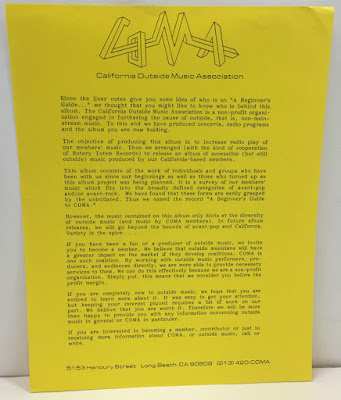
V.A. - A Beginner's Guide to COMA (1985)
A treasure trove of underground prog from when, pairing the formal inquisitiveness of the format with a more DIY garagey m.o. (no orchestra for you) and a twisted outlook on the general notion of reality, some sort of progressive scene (even if no longer self-described as such) finally caught on aesthetically (and in no other way) in the USA, which begs the philosophical question this gestalteanly wacky sampler from Rotary Totem Records (founded by James Grigsby, of Motor Totemist Guild and U-Totem, ehr, fame?), for the proto-pynchonesque "California Outside Music Association" = COMA (manifesto included), preemptively strove (while ultimately knowing it couldn't help but fail) to clarify: if the 80's had actually been a great decade for real progressive music, but no one was then to hear it, did it really make a sound?