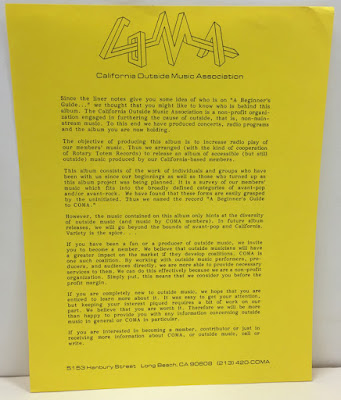
A treasure trove of underground prog from when, pairing the formal inquisitiveness of the format with a more DIY garagey m.o. (no orchestra for you) and a twisted outlook on the general notion of reality, some sort of progressive scene (even if no longer self-described as such) finally caught on aesthetically (and in no other way) in the USA, which begs the philosophical question this gestalteanly wacky sampler from Rotary Totem Records (founded by James Grigsby, of Motor Totemist Guild and U-Totem, ehr, fame?), for the proto-pynchonesque "California Outside Music Association" = COMA (manifesto included), preemptively strove (while ultimately knowing it couldn't help but fail) to clarify: if the 80's had actually been a great decade for real progressive music, but no one was then to hear it, did it really make a sound?
Wednesday, 8 December 2021
Riccardo Cocciante - Mu (1972)
Now that the letters of the greek alphabet, such as Mu, are getting a (literally and metaphorically viral) bad wrap, through no fault of their own, it is perhaps time for us to be reminded that letters, syllables, the words they make up, are all just innocent victims of how we choose to name things, and "Mu" - from cows to Cocciante, by way of crypto history loonies - has been for centuries a consistent source of entertainment, one that deserved a better fate in popular memory.
Take for instance this record which, unlike new SARS-CoV-2 variants, is a nice surprise; one I wouldn’t have expected to find while scraping down the
barrels of Italian singer-songwriter prog: that’s like a cocktail mixing
amaretto, limoncello and grappa; what could possibly go wrong? Well, go figure,
not all that much, for once at least (and I do mean once: all the other Riccardo Cocciante records this one misled me to hear were a sappy waste of my time). The
songwriting is rather decent, sometimes even inspired (the adamic Era mattino sul mondo is actually mellotrony-gorgeous; A Dio is beatifically effective; and the genesiac opening and eschatological finale are not at all something I am displeased with), while the arrangements are evocative enough to befit it, keeping things interesting
without overtaking the show or merely pandering to the star’s sense of self-importance.
As naïve as its inspiration warranted, the narrative (put to words by two hired parolieri) goes through a mystical hodge-podge of (at least) biblical and buddhist tropes injected (along with a jarring reference to 'a gram of heroin' (to make everything sound allegorically contemporary and relevant I guess)) in the 'lost continent of Mu'; all of which could very well befit the hermetic machinations of Charles Portis’ Masters of Atlantis. Nonetheless, the constellation of session musicians and arrangers brought into this affair does sound enthusiastic enough about it to make things reasonably compelling, even when they tread on more laughable grounds (e.g. Festa or Vita). Still, if you have the cultural audacity to believe that the subject could still be suitable for more highbrow endeavors (well, sort of highbrow: you would have to hear Mike Patton shriek and 'sing' for this) you should flee towards Eyvind Kang’s Athlantis instead (however fleeting the relation of
the Latin sources he used – Giordano Bruno, primarily - to the work’s title may apparently be).
I was also quite amused for a while by the
verses “Tu, col tuo corpo di fango, non ricordi che in te c’è qualcosa di Mu”. Turns
out it was another of my occasional forays into the wonderful realm of misheard
lyrics, as I imaginatively mistook plain, boring “piú”, for the much more entertaining Mu, what with its bovine overtones and all. It was fun
while it lasted, though, and I look fondly on that time.
In full, for true Gnomons (complete the triangle, scale that cone):
Monday, 25 October 2021
Forest - Forest (1969)
Most
records you own for the music, some for the artwork, a rare few for the liner
notes – say, Pynchon’s prose on Nobody’s Cool, and Spiked!, Geoff Dyer on Rabih Abou-Khalil's The Sultan's Picnic, or perhaps most notably (I mean, who would have guessed?), Dave Stewart’s heart-warming
and mouth-giggling recollections on some National Health reissues (not that the music within wasn't reason enough as well for owning some of these).
I’d place Forest’s
debut firmly on that pile. Musically it was yet another good-natured, if rather naïve, take on late 1960's expanding (and often simultaneously simplistic) notions of what constituted folk music (from which any correlation with hand calluses (other than guitar-inflicted) was swiftly removed); but most
memorable about it is definitely John Peel’s early creative writing workout on the sleeve,
beginning with: “In the autumn of a year which historians have, with the aid of
carbon dating, pin-pointed as 1968, I was in the gay carbon-monoxide cloud some
authorities call Birmingham, in pursuit of a ladye with what I considered to be
a dangerously high nubility quotient.”
I’ll take a
copy, please.
Thursday, 7 October 2021
Black Bombaim - Far Out (2014)
Stoner rock trio, with a collaborative mind, this time featuring electronic warping (from Luís Fernandes) and a free(ish) sax (from Rodrigo Amado) - which make a considerable difference from their stonier, rockier releases (also aided by the unusually short running time, preventing things from getting too dragged-out (perhaps almost an inevitability for the genre) even if they are concentrated in two long tracks).
Black Bombaim's subsequent star-power reunion with Peter Brötzmann, from 2016, constitutes a more obvious (and self-serious) entry point for the skronky music lover, but Far Out just might be a tighter and friendlier affair, with all participants in more or less equal footing, with no particular pedigree qualms about who goes on top.
Particularly good for when you want to take your socks off but don't feel like bending down.
Sunday, 22 August 2021
Mercedes Sosa - Cantata sudamericana (1972)
A strange
one from La Negra. As a musical and
political icon, Mercedes Sosa came into some more conceptual projects such as this (spearheaded by composer Ariel Ramírez) which
tended to be marred by their programmatic intentions (Misa Criolla as well, also composed by Ramírez, remarkably failed to impress me, while sadly becoming a most
poor contender for trademark release from Sosa). Mercedes did her best work not
when handling abstract ideological proclamations, but by embodying them in
identifiable characters and narratives, which her all-powerful and empathetic
voice could easily make pulse with emotional blood, even in the briefest vignettes
(e.g. Zamba de los mineros, among many others). Whenever the
songs turn into pamphlets they fail to be as humanly engaging, and thereby
forego the very political efficacy they seek.
That is
worsened here by the strictly musical discourse, which sounds like a kitschy pan-american
take on the musical traditions of the various people for whom the work wishes to speak
for, but doesn’t seem to credibly relate to (and where did that manic harpsichord spring from?). So, despite claims to some kind of "authentic" inspiration, we're offered mostly a collection of musical
cartoons (which is also possibly what all musical forms tend to, to some extent, the minute they begin to (need to) be defined as authentic; but there's no need to get into that right now). Maybe something could be said (even if it doesn't do much for me) for
the cultural re-appropriation of musical discourses already filtered by
north-american musical hegemony; Bossa Nova being a case in point (and also one of the most awkward pastiches found in this Cantata) or, more
radically, Tropicalism. This is not a good poster-record for that angle
though, as I find it veering towards hollywoodesque exotica, of all things. I was almost surprised for not hearing, at
some point, Yma Sumac pushing Mercedes away and taking over the show.
Her voice could make just about anything sound great, sure; just not all.
Wednesday, 18 August 2021
Psico - Al’s / Epitáfio (1978)
The least progressive thing in the often quite progressive realm of portuguese music (particularly coming from a folk angle) were its very few stints with stereotypical 70's prog rock. This punchy and inventive fusionesque single from 1978, the only recorded output from a barely known and unstable outfit that never got to make a proper vinyl statement after a decade or so of playing the occasional live show, might be the only thing I would salvage without reservations from that not-even-a-scene.
I can't imagine musical things getting much more one-off than this.
Friday, 13 August 2021
Kimmo Pohjonen - Kielo (1999)
Hindsight
hinders Pohjonen’s debut. It inevitably sounds like a test record where Kimmo - quiting the folk scene (though not necessarily its roots) to unleash the primal voices in his head, with a mutant accordion by his side - is trying out techniques and stylistics that would become his bewildering
trademark, but which hadn’t yet morphed into a fully formed, coherent musical
idiom, as there is nothing to be found here that Pohjonen didn’t do better
later. You can appreciate where his music was going, but you can also frustratingly hear that it hadn’t gotten there yet - and, in it, you also get a bonus sneak
preview of some of the questionable choices (like those proto-techno beats) he
would devolve into after his streak of most original and uncompromising albums;
so, pretty much a time-travelling worst of both worlds. Once you’ve trodden the
unique and exhilarating soundscapes he would shortly open up, it’s hard to enjoy this initial effort for
what it was at its time; your audition is caught up in a temporal limbo
in which this record has no present; it’s being constantly projected onto a
musical future it relates to but cannot match.
Susana Santos Silva - All the Rivers, Live at Panteão Nacional (2018)
Solo improvisation done right - again! - in an excellent rejoinder to Carlos Zíngaro's Solo, also recorded in a major monumental space, and making full use of it as an echo chamber that can actually serve to engage reflexively in an open-ended dialogue with oneself, and not just to toot one's own horn. As the building extends a bedrock of drony reverb, both following the instrument's thrusts and queuing subsequent ones, the performance is organized by design around an artefactual call and response dynamic that, interestingly, echoes some electroacoustic experiences, but ingeniously executes them in non-electro, luddite fashion. In that regard, it could almost be taken as a practical exposé, by counterexample, on how the undiscerning fascination with technological novelty in artistic production can occasionally get to be aesthetically redundant, just lazy, or even backwards.
Proto-acousmatic explorations of refractive space instead of "zero tolerance for silence"? Noice.
Solo improvisation done right, in the right architectural atmosphere, by the portuguese father figure of that scene. A bit more tongue in cheek, and Zíngaro's record could actually have been called Duo, as you find him very deliberately playing off the architecture (also making me dance about it now) in a fascinating game of acoustic squash that lays the ground for an actual dialogue with his acousmatic self, through which the whole performance can aesthetically grow.
Instant composition and sound design instead of all random screeches? That's refreshing.
What is wrong with Pat Metheny? How can the same
person get so entrenched in the jazzy middle of the road and then,
unexpectedly, skid so aptly towards the occasional experimental wonderland? Zero Tolerance for Silence only seemed
to exist to make a point, and not a very interesting or original one at that (Metal Machine Music, at least, having already taken its place in aesthetic existence). This,
however, is the righteous successor to Metheny’s exalting pas de deux with Ornette Coleman on Song
X (which didn't even require busting out Lonely Woman to stake its claim on the reaffirmation of an enduring legacy).
Now, one could be tempted to credit John Zorn's compositions for most of Tap's excellence, but the wild
arrangements and energy are the things that really make it - and set
it apart from the middle-ground of Zorn's overall Book of Angels series (most enjoyable
as it is) - even if the album loses a bit of steam and invention towards the end.
It's as if the mystical imaginary of Zorn’s tunes magically turned on the
lights in a musical dungeon of sorts where Metheny, waiting for some
mischievous sonic opportunity like this to arise, had been working for years on
a trove of mutant devices (orchestrionic marimba? yum) and devious ideas, which I would not have expected to
find lurking under his gentle mane.
Out-there
artists out there, please: call out to Pat, make him feel cared for, keep him busy, take turns
at it, do what you must; everyone will be all the better for it.
Pat, should
it be that no one has ever had the gall to tell you as much, please allow (on this occasion not so much, but in general definitely) humble me:
this is the way.
Artistic pretension in rock music has both pushed musical history forward and littered bargain bins in record stores (sometimes at the same time). It can strike in the oddest places, and a band that you feel would feel most at home sounding off in a pub is arguably among them. This record essentially revisits some of the Levellers' (apt name) politically fueled anthems, adding lush string arrangements, and what we end up with is a disconcerting sort of left-wing anarchic mash-up rock musical; one which one could imagine making it off-Broadway. I am intrigued as to how this fits in the band’s trajectory, how one-off it might really be, but not sure how soon I’ll pursue the matter. There is nothing specifically wrong with any part of this, but mashed together the sum feels somewhat incongruous, occasionally taking on an andrewlloydweberish flair, which doesn't really match the proletarian subject matter, and is certainly not my cup of meatloafy tea.
All can be forgiven, though, on the merits of the perfectly timed and executed revival of the Zounds' punkish classic "Subvert" (which remains a great piece of modern-day agitatsiya), and if some youtuber has not yet used it to score the sequences in Fight Club where Durden and associates season food items with bodily fluids while moonlighting in catering, and generally wreak other surreptitious havoc as "infiltrates" in “the system” and what not, well, the internet is just failing us all.
Wednesday, 31 March 2021
Scott Walker - Scott Walker Sings Jacques Brel (1981, comp.)
Other than
the possibility for English speakers who don’t understand French (snob alert) to come close to enjoying Brel’s lyrics - their sort of simultaneously picaresque and world-weary existencialism - if you dig Brel himself, I
could never truly fathom what real use you might have for Walker’s renditions of his
songs, committed (and rather faithful) as they may be. Not to say that Sons Of, If You Go Away, and Next, are not dramatically effective; My Death actually beats the original arrangement; but then things like Jackie and The Girls and the Dogs turn the whole proceedings into a camp-fest (or reveal the underlying campiness of it all), which could have informed quite a few more notes on the subject from Susan Sontag.
For one thing, Scott never really reached that perfect balance
between melody and verbal rampage that Brel mastered so well; you find
him jumping conspicuously from one register to the other. If nothing else, Walker’s gorgeous operatic register came at a price, and just wasn’t nimble enough to do it
seamlessly, making everything too emphatic and choppy, while Brel integrated it into a single uninterrupted flow. Walker's enunciation single-handedly and automatically highlighted and made symbols out of almost every other word. In Brel, words were primarily narrative tools, which drew their power from the sequence they were placed in, not from being vocally singled out all the time; his occasional morceaux de bravure only existing and making full sense in a diegetic context.
Also, Brel
made you feel like he was coming from a place of experience, and pulled you in
to briefly share in snippets of life; Walker sounded like he was telling someone
else’s stories, pointing to their experiences, fascinated by them, as
obsessively as only someone who is looking outside in might - kind of like
pervs getting their kicks online (so I'm told).
Finally, orchestrally, this sort
of stages an incongruous clash of traditions as, while Walker’s more than worthy arrangers back in the day (specifically, Peter Knight and Wally Stott) did rather interesting things with his own material, in these songs the added symphonic
bombast does not really befit the subtleties of the
storytelling, which in Brel was closely shadowed by a more attentive, precise, and subdued
orchestral backdrop.
Still, it clearly was a step Scott needed to
take in order to reach a steady place of his own, with Brel serving as a sort of surrogate
for Walker to start testing the water regarding the exposure of his own
troubled worldviews and troubling obsessions to his then wide-eyed teen public - whose tolerance to his extremely carnal, near grotesque, enunciation of "ass", "piss", “thighs”, “fat”, and other body parts, traits, and secretions, quickly faltered (the sort of thing that was also less noticeable in Brel perhaps in part because, and to quote the only thing remotely quotable from the Matrix movies, cursing in French is like "wiping your ass with silk") and, in
retrospect, understandably so, as it announced the scatological doom he would
sonically befall upon us all, which was hardly gonna tickle everyone’s fancy. As such, while this is a bridge I quickly burned from my listening habits, considering
all that came from it, it just might qualify as one of the most productive
failures in music history.
Thursday, 25 March 2021
Manuel Barrueco - 300 Years of Guitar Masterpieces (1991, comp.)
The booklet
holds little original recording information, but this constitutes basically an anthology
of some of Barrueco’s initial, by then long and widely unavailable, recordings, from the late 70's, early 80's – ranging from Bach, Scarlatti and Cimarosa, to Villa-Lobos, Guarnieri and a Carlos
Chávez gone wild, and including Albéniz and Granados (some of my favourites here; particularly the Spanish Dances, which Barrueco would come to record again, beautifully, in their entirety), but also Giuliani and Paganini (more in the virtuoso meh department). Still, a nice spread.
Those recording dates, in the early years of his career, may have something to do with the near absence of production values (not) to be heard,
contributing to a very dry sound which underscores Barrueco’s distinctive
picking technique: very terse, with the strings in maximum tension, making him
sound here, even more than usual, like he’s playing with barbwire. In his case that is not necessarily a bad thing, though. Unlike most classical guitar
recordings, which favor echo-laden environments, like churches, to enhance the
instrument’s feeble sound projection, this sounds very direct and close captured.
Every note stands pretty much naked before us, with practically no reverb (from itself, the previous or the accompanying notes) to shroud it. It is as if he was playing
right beside you, and all that proximity gives him no room to hide any
shortcomings, which actually grants him the opportunity to show that wiggle
room to be something he had no need for in the first place. The rollercoaster renditions of a few of Villa-Lobos' Estudos, particularly, go for a technical suspension of disbelief, that actually unravels new textural ground in some of them (still, the Suite Popular Brasileira sounds anaemic by contrast, so there was still some interpretive room to grow - as he would later show with his benchmark recording of the 5 Prelúdios).
A guy who can put most
guitarists playing in cathedrals to shame while he sounds off in the pantry: that’s
Barrueco for you, and he was just getting started.
Wednesday, 24 February 2021
Terry Riley - Persian Surgery Dervishes (1972)
If onanism made
music, or if music could go down on itself, I’m thinking it would sound like
this. These tantric, relentless organ runs just endlessly wrap themselves over
and over like a musical Ouroboros. I mean, good for Terry, I guess; what you do
with yourself is your own business; but, to pursue the metaphor, I don’t think you should be doing it
in public, and I, for one, would rather not be present for it.
Time to check what new versions of In C are in town...
Sometimes one forgets to check up on Robert Plant, but, from the evidence, I believe we can assume he’s keeping well fed and continues to be a very nice lad, minding his business, doing his psychedelic-country-folk-rock thing. Still, on the distinctive strength of the title track, feeding off Plant’s long running, highly promising, but never fully realized dalliance with North African music (the reunion with Jimmy Page, in No Quarter, probably came closest), I am truly still hoping for the likes of a full-on "Robert Plant presents the Master Musicians of Jajouka".